Software for Facility Services Companies With Many Client Sites
Software for a facility services company has to do something most facilities software does not: keep many client sites separate while running one crew, one payroll and one schedule across all of them. In practice that means a site for each client with its own scope, a time clock that knows which site a worker is at, inspection checklists and photos as proof of service, call-out coverage, supplies per site, and reports each client can see without seeing anyone else's data. Buy for those first. Everything else is a nice-to-have.
We write this from the operator's seat: our founders run a facilities services company across client sites, on MAFM.
The industry in three numbers
- 83,480 janitorial service establishments. BLS quarterly census data for the first quarter of 2026 counts 83,480 private establishments in janitorial services (NAICS 561720), employing 1,060,484 people in March 2026. That is about 13 employees per establishment. Facilities support services (NAICS 561210), the firms that run whole buildings, add another 8,333 establishments and 180,622 employees.
- $17.71 an hour. The median hourly wage for janitors and cleaners across all industries was $17.71 in May 2025, across 2,209,760 jobs, according to the BLS occupational wage release.
- 4.6% a month. BLS does not publish a turnover rate for janitorial services alone. The closest published group, professional and business services, had an average monthly separations rate of 4.6% in 2025 in the JOLTS annual tables. Treat it as context, not a janitorial figure.
Put together: lots of small operators, an hourly workforce, and people coming and going every month. Software for this business has to be learned in minutes by someone on their first shift, on their own phone.
What clients write into contracts now
Public contracts show where client expectations are going: from "clean the building" to "prove you cleaned it, and prove someone checked."
- Arkansas's statewide janitorial services contract requires the contractor to run an inspection system with a checklist, and says: "The checklist must be signed and dated to indicate the time the inspection was completed. The person who performed the Janitorial Services shall not be the one to do the inspection." The signed checklists stay on file and go to the state on request, and any deficiency needs a corrective action plan.
- An Iredell County, North Carolina janitorial RFP from 2024 asks for the restrooms in one building to "be checked a minimum of once daily and sign off on cleaning checklist on door."
A paper sheet on a restroom door meets the second one. The first one, an inspector who is not the cleaner, signing with a date and time, with records kept and produced on request, is where paper starts to cost real hours. Multiply it by every client that asks.
What the software has to do
- One site per client, kept apart. Each client's buildings, requests, checklists and reports in their own space, so a client never sees another client's data, and your staff see only the sites they work.
- A time clock that knows the site. Workers clock in at the client site, not at your office, and the clock should know whether they are actually there. Payroll records have to be kept for three years under the federal FLSA recordkeeping rules, and time cards for two.
- Checklists with a time, a name and an inspector. Separate the person who cleaned from the person who checked, as the Arkansas contract requires.
- Photos that cannot be swapped later. A photo is only proof if it was taken at the time and place it claims.
- Call-out coverage on the shift. Someone always calls out. The calls you make to cover the shift should be logged where the shift is, as our post on shift call-outs explains.
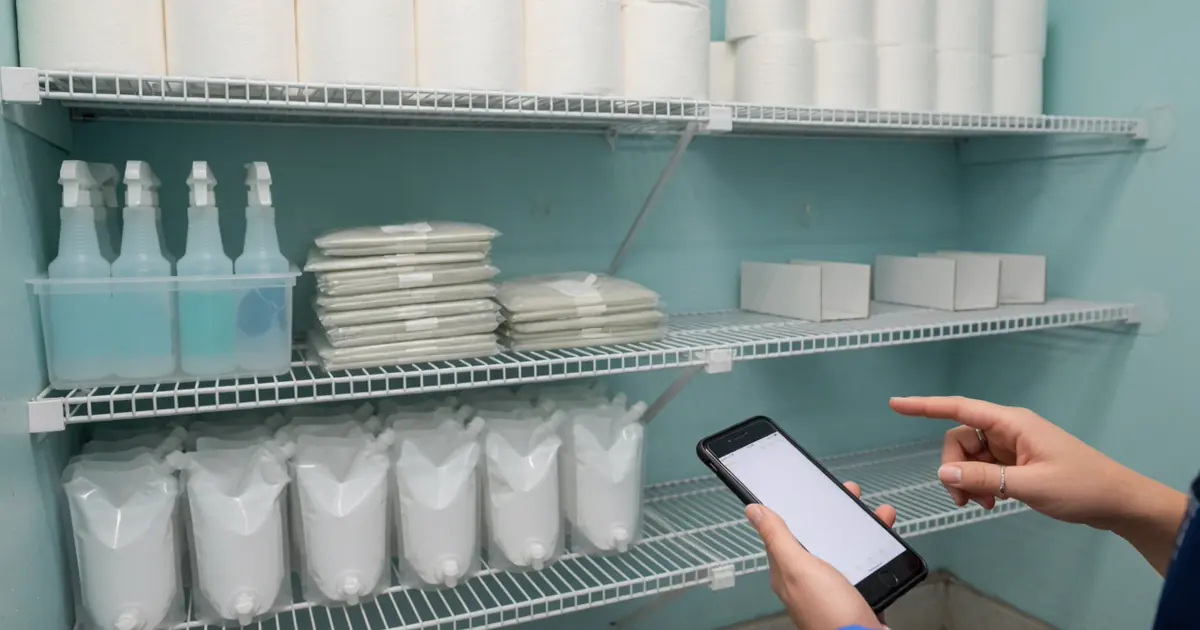
- Supplies per site. Each client's closets counted and reordered, so supply costs can be billed or at least explained. See janitorial supply tracking.
- Different scope per client. One client buys cleaning only, another buys cleaning, maintenance and the mailroom. The software should switch modules per client rather than show everyone everything.
- Your brand on it. If the client sees the app, they should see your company, not a software vendor's.
The demo shows the checklist assistant in MAFM, with sample data: asked to add a restroom group for floors 3 to 5, it previews the changes, and nothing is saved until someone applies them.
Questions to ask before you buy
- Can I add a new client site in an afternoon, with its own checklists and its own people?
- When a worker clocks in, what does the system know about where they are?
- Can my client log in and see their own site's checklists and requests, and only theirs?
- What does a new hire need to learn on their first night?
- Can I put my company's name and logo on what clients see?
- What happens to my data, and my clients' data, if I leave?
How our founders run it on MAFM
MAFM was built inside a working facilities company, and it is how our founders run their client sites today. Each client site has its own geofence, so the time clock knows whether a worker is on site. Cleaning photos lock once they are taken. Modules are switched on per client, and the whole platform can carry your brand: facility services companies license it as their own through our Operator License.
Frequently asked questions
What software do janitorial companies use?
Most use a mix: a time clock app, a scheduling tool, paper or app checklists, and spreadsheets for supplies and invoicing. The growing alternative is one system per company that keeps each client site separate while sharing the crew, schedule and payroll records across them.
How do cleaning companies prove work was done?
With inspection checklists signed and dated by someone other than the cleaner, time-stamped photos, and time clock records tied to the client site. Some public contracts, like Arkansas's statewide janitorial contract, now require signed and dated inspection checklists kept on file.
What is a geofenced time clock?
A time clock that checks the worker's phone location against a boundary drawn around the client site at clock-in. It shows whether the worker was actually on site, which matters when one company staffs many buildings and the client pays by the hour.
Can facility services software be white-labeled?
Some platforms can. With MAFM, a facility services company can license the platform under its own brand, so clients see the operator's company on the app and reports rather than the software vendor's.
If you run crews across client sites, talk to an operator who does the same.