How to Track Janitorial Supply Inventory Across Closets
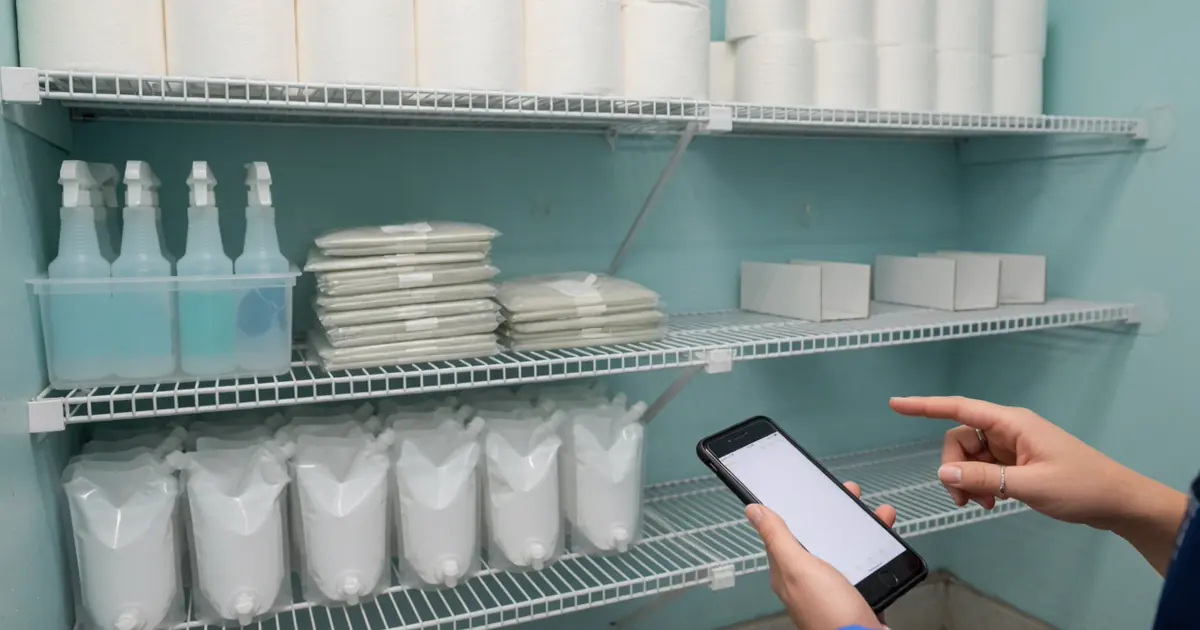
To track janitorial supply inventory across several closets, count every closet on a fixed day, record what was delivered since the last count, and work out usage per item as last count plus deliveries minus today's count. Add the closets together for one total per item, reorder when that total falls to a reorder point you set from real usage, and keep the chemical safety data sheets where the crew can reach them on every shift.
That is the routine. Here is how to set it up so it survives the person who started it.
Usage is a calculation, not a guess
Nobody writes down every roll of paper towel they take. You do not need them to. Usage falls out of two counts and the deliveries in between:
Used = last count + received − this count
A worked example for paper towels across three closets, counted every Monday:
| Closet | Last Monday | Received | This Monday | Used |
|---|---|---|---|---|
| Lobby level | 14 cases | 6 cases | 9 cases | 11 cases |
| Floor 3 | 10 cases | 4 cases | 8 cases | 6 cases |
| Floor 7 | 16 cases | 2 cases | 14 cases | 4 cases |
| All closets | 40 cases | 12 cases | 31 cases | 21 cases |
Two things show up straight away. The building used 21 cases in a week, which is your demand figure for reordering. And the lobby closet goes through almost three times what floor 7 does, which is either real traffic or product walking out of an unlocked door. Either way, you now know where to look.
Set a reorder point from your own usage
The reorder point is the stock level at which you place the next order. The usual formula:
Reorder point = average usage per day × lead time in days + safety stock
Using the example above: 21 cases a week is 3 cases a day. If your supplier takes five days to deliver and you want two days of safety stock (6 cases), the reorder point is 3 × 5 + 6 = 21 cases. When the building total drops to 21, you order.
Reorder point, safety stock and par level are standard inventory terms, all defined in the ASCM Supply Chain Dictionary (20th edition, 2026). Par level is the simpler cousin often used per closet: the quantity a closet should be topped back up to on each restock. Use par levels to restock closets from a central store, and a reorder point on the building total to buy from the supplier.
We looked for a published benchmark for janitorial supply cost per square foot that separates supplies from labor, and did not find one in public material. Benchmark against your own history instead: usage per week, per building, with a note when something changes, like a new tenant or a switch to a different towel dispenser.
Keep the safety data sheets where the crew can reach them
Cleaning chemicals bring a legal requirement that paper towels do not. Under OSHA's Hazard Communication standard, 29 CFR 1910.1200(g)(8), the employer "shall ensure that they are readily accessible during each work shift to employees when they are in their work area(s)." Electronic access is allowed, as long as it creates no barriers to immediate access. A tablet in a locked office at 2 AM does not count.
Two more points from the same standard that matter for supply closets:
- Containers must be labeled. A spray bottle filled from a concentrate needs a workplace label with the product identifier and its hazards.
- Some products are exempt. Consumer products are exempt where "the employer can show" they are used in the workplace for their intended purpose, with exposure no greater than a consumer would have. A bottle of retail glass cleaner used as directed may qualify. A gallon of concentrate diluted all night by a crew of five usually will not.
There is also a date coming up. OSHA updated the standard in January 2026, and employers must, as necessary, update workplace labels, their written program and training for newly identified hazards by November 20, 2026 for substances and May 19, 2028 for mixtures. If your supplier has sent revised safety data sheets this year, check them against the labels on your secondary containers.
Why supply tracking quietly stops
The common failure is not a bad method. It is a method that lives in one person.
A 2023 audit by the Citrus County Clerk in Florida looked at a parks and grounds maintenance department and found: "The department no longer uses IPS to manage its inventory of janitorial supplies." IPS was the county's own work order system. The staff member who had kept the inventory in it had left, and the know-how left too. The auditors' recommendations were training and a written procedure.
The lesson for any facilities team: the count should be a short, repeatable task anyone on the crew can do from a phone, on a fixed day, with the math done for them. If it needs one person who knows the spreadsheet, it will stop the week that person leaves.
A routine that keeps going
- List every item and every closet once, with the unit you count in (cases, rolls, gallons).
- Count on a fixed day, every closet, at the same time of day.
- Record deliveries against the closet they went into.
- Let the system work out usage per item and per closet, then the building total.
- Reorder from the total at your reorder point; restock closets to par from the central store.
- Review monthly: usage per item, any closet that runs far ahead of the others, and safety data sheets for anything new.
How MAFM handles it
In MAFM, you count a shelf, enter what came in, and the app works out what was used for each item and logs it as consumption, using the same formula as above. Counts from every closet roll up to one total per item, so the reorder decision is made on the building, not on whichever closet someone happened to check.
The demo above uses sample data. See the asset and inventory solution for the full module, or our post on software for facility services companies if you supply several client sites.
Frequently asked questions
How do you calculate janitorial supply usage?
Usage equals the last count plus everything received since, minus the current count. Count every closet on the same day each week, add the closets together, and you have usage per item for the whole building without anyone logging what they take.
How often should janitorial supplies be counted?
Weekly works for most buildings, on a fixed day. Count more often for fast-moving items in high-traffic buildings, and less often for slow items like floor finish. The fixed day matters more than the frequency, because it keeps usage comparable week to week.
What is a reorder point for cleaning supplies?
It is the stock level that triggers a new order: average daily usage times the supplier's lead time in days, plus safety stock. Set it from your own usage, and revisit it when usage or lead time changes.
Do cleaning chemicals need safety data sheets on site?
Yes, for hazardous chemicals covered by OSHA's Hazard Communication standard. The sheets must be readily accessible to employees on every shift, on paper or electronically without barriers. Some consumer products used as a consumer would use them are exempt.
If supply counts live in a spreadsheet that one person owns, talk to an operator who runs their own closets on MAFM.