Commercial Mailroom Procedures for Tenant Mail and Packages
An office building should handle tenant mail and packages with written commercial mailroom procedures that cover five steps: receive every item in one restricted place, log it the moment it arrives, notify the recipient, release it only against a signature or scan from the right person, and follow a written rule for items nobody collects, items a tenant refuses and items that look suspicious. The log is the point. Once the building signs for a parcel, the carrier's responsibility ends, and the building's record is the only proof of where it went next.
Most package disputes in office buildings come down to the same gap: a parcel was signed for at the dock, and nobody can say who took it from there. The procedures below close that gap, and they are built from U.S. Postal Service rules, the federal mail management regulation and a state audit of a real mailroom.
Can a building sign for its tenants' mail?
Yes, in most cases. The Domestic Mail Manual, section 508, says that "unless otherwise directed, an addressee's mail may be delivered to an employee, to a competent member of the addressee's family, or to any person authorized to represent the addressee." A front desk or mailroom that tenants have agreed can receive for them fits that description.
Three limits matter in practice:
- Signature mail needs a real signature. For Priority Mail Express, Registered Mail, Certified Mail, mail insured for more than $500, Adult Signature, COD and return receipt items, the manual says the piece may not be opened or handed over before the recipient "signs and legibly prints his or her name" on the form or label. A company can get a postmaster-approved hand stamp for this, but only after it tells the postmaster in writing who is authorized to accept accountable mail.
- Restricted Delivery is different. Mail marked "Restricted Delivery" goes only to the addressee or to a person the addressee authorized in writing, for example on PS Form 3801 or by letter to the postmaster. A building's general authority to receive mail does not cover it.
- Responsibility moves to you. The manual is plain about it: "USPS responsibility ends when the mailpiece is delivered to the addressee (or another party, subject to 1.0)." From that signature on, a missing parcel is a building problem.
One more case to know before you start: if accepting mail for other people is a service you sell, the Postal Service may treat you as a Commercial Mail Receiving Agency. Section 508.1.8 defines a CMRA as "a business that, in whole or in part, accepts the delivery of U.S. Mail on behalf of another person or entity as a business service," and says an office business center that provides private offices and business support services is considered one. CMRAs must register with the Post Office and keep a PS Form 1583 for each customer. If you run executive suites or coworking space, read that section and talk to the postmaster responsible for delivery before you set anything up.
How mail reaches an office building
The Postal Operations Manual sets the default. Under section 631.3, "centralized delivery service is for all business office buildings, office complexes, and industrial/professional parks": call windows, locked mail receptacles, cluster box units, wall-mounted receptacles or, in high-rise and multi-tenant buildings, mechanical conveyors. Delivery to single points or door slots "provided by business management" is an exception that a USPS district manager or designee has to grant.
That shapes the job. Letters for tenants with their own locked boxes go straight into those boxes and never touch the building. Everything that does not fit (parcels, signature items, oversized envelopes) and everything from private carriers comes to whoever the building has put at the receiving door. Those items are what your procedure is really for. UPS, FedEx and other carriers have their own signature and release terms, so check each carrier's rules for the services your tenants use.
The receiving and release procedure, step by step
This is a procedure a mailroom of any size can run, from one person at a lobby desk to a full mail center.
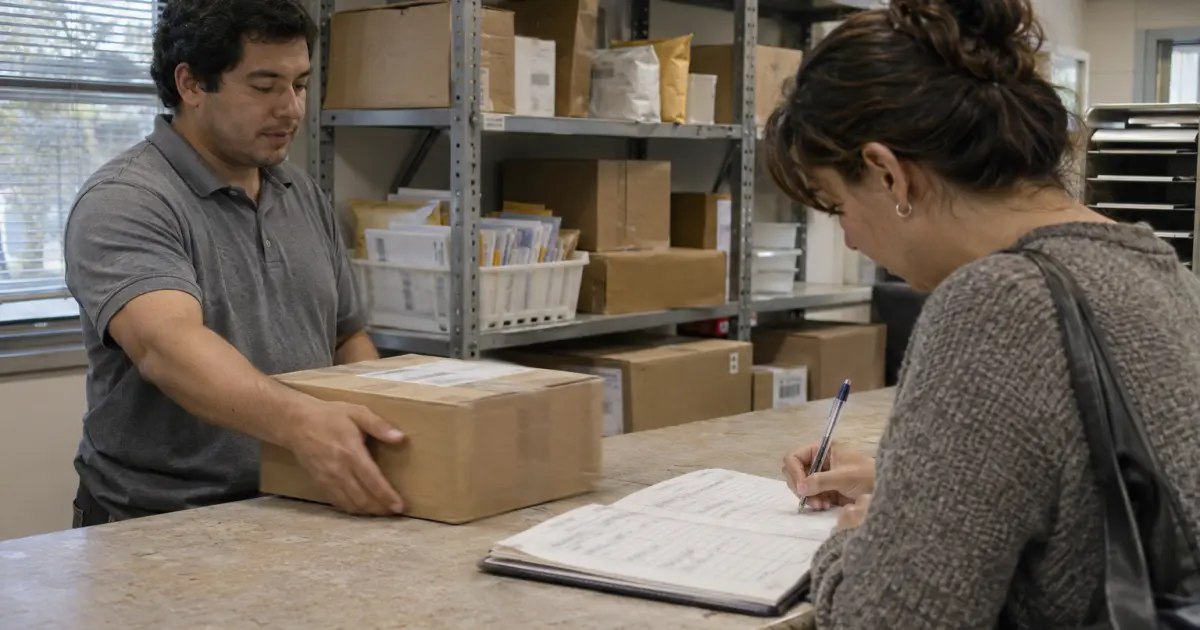
- Receive in one defined place. All carriers deliver to one counter or dock, at known hours. The Postal Inspection Service's best practices for mail center security say to "require deliveries to be made in a restricted, defined area." Packages left at suite doors or on a lobby bench are not received; they are abandoned.
- Log every item on arrival, before it is shelved. Record a unique entry for each piece: date and time, carrier, tracking number, recipient and suite, a short description, condition, and the name of the person who received it. Note visible damage now, with a photo, not when the tenant complains.
- Keep accountable items apart. Registered and other signature mail gets its own shelf or locked bin. The same USPIS guidance says to keep Registered Mail "separate from other mail" and to "document transfer of Registered Mail by requiring the receiver to sign for custody."
- Notify the recipient the same day. One notice per item, by email, text or app, sent from the log so the notice and the record match. Tenants should know the pickup hours and what ID or confirmation you will ask for.
- Release only against proof. The person collecting signs or confirms in the log, and staff record who released it and when. For anything signed for at the dock, the release record is what completes the chain of custody: carrier to building, building to tenant.
- Follow up on what sits. Send a second notice after a set number of days, then escalate to the tenant's office contact. Write your holding period into the tenant handbook or building rules, and say what happens at the end of it (returned to the carrier, returned to the sender, or handed to the tenant's office manager). Pick a period that fits your storage space and apply it the same way to everyone.
- Reconcile daily. At close, every item logged in that day is either released, still on the shelf, or explained. A quick count of the shelf against open log entries catches problems while the people involved still remember them.
Refused, misdelivered and former-tenant mail
- Refused at the counter. An addressee may refuse a mailpiece when it is offered. After delivery, DMM 508.1.1.3 lets the addressee mark an unopened piece "Refused" and return it within a reasonable time, but Registered, insured, Certified, COD and Adult Signature pieces cannot be refused and returned postage-free that way. Log the refusal and hand the item back to the carrier; do not let refused items join the general shelf.
- Mail for people who have left a tenant company. Section 508.1.5.1 says mail addressed to someone by name or title at an organization's address "is delivered to the organization, as is similarly addressed mail for former officials, employees, contractors, agents, etc." In a multi-tenant building, that means it goes to the tenant company, not into a building drawer.
- Mail for tenants who have moved out. Do not hold it indefinitely or open it. Ask departing tenants to file a change of address before they leave, and return anything that still arrives to the carrier as undeliverable.
Suspicious letters and packages
Put the suspicious item rule on paper and on the wall, because the person who meets one will not have time to look it up. The Postal Inspection Service's suspicious mail page says suspicious mail "often has no return address, excessive tape and postage, and/or misspelled or badly written words." Its Poster 84 adds restrictive markings, an incorrect title or a title with no name, oily stains or discoloration, a strange odor, protruding wires, an unknown powder, and parcels that are rigid, bulky, lopsided or uneven.
If staff suspect one, the inspectors' instruction is to "isolate the item, maintain a safe distance from the item, wash your hands, and immediately call Postal Inspectors at 1-877-876-2455 and state 'emergency.'" If medical attention is needed, the same page says to contact local authorities immediately. Leave the item closed.
Lessons from a state mailroom audit
In August 2018, the Florida Department of Business and Professional Regulation's inspector general published an audit of its own mail room, a five-person unit that received, logged and delivered all mail and packages for the department. The findings read like a checklist of what goes wrong in any building mailroom:
- One person did everything. For overnight mail containing checks, the same employee was "responsible for opening the mail, identifying that the parcel contains revenue and/or other sensitive personal information, recording the mail and associated revenue into the SendSuite system, and delivering the mail and associated revenue." About $200,000 a month passed through that process.
- The log was wrong. In June 2017, $213,800 was logged over 22 delivery days, but only three days had the amount and number of checks recorded accurately. When a parcel held several checks, "only the first check is recorded," which happened 40 times that month, so "no accurate reconciliation of the overnight mail revenue could be performed."
- Anyone could walk in. There was no badge reader on the door, the one camera covered "approximately ¼ of the physical location," and nobody reviewed the footage. Auditors watched non-mailroom staff walk in "on multiple occasions over multiple days."
The fixes the auditors recommended carry over to any building: deliver checks and other valuables to the recipient "unopened, after logging"; split receiving, recording and delivery between different people where you can; lock or badge the mailroom door; and have a supervisor spot-check the records. The USPIS guidance makes the same point about money in the mail: "establish adequate controls to fix individual responsibility for any losses that may occur."
Write it down: a mail security plan
Federal agencies have to do this by regulation, and their checklist is a good template for any building. Under 41 CFR 102-192.30, agencies "must have a written mail security plan for each facility that processes mail, regardless of the facility's mail volume." Section 102-192.35 lists what the plan must cover, including a risk assessment, a plan to protect occupants "from hazards that might be delivered in the mail," operating procedures, training, rehearsed emergency responses, a communications plan and an annual review.
A private office building is not bound by that rule, but a two-page version of it answers most of the questions a tenant, an insurer or a new hire will ask: who receives, where, how items are logged and released, how long they are held, and what to do with a suspicious one. Keep it next to the rest of your building procedures, and keep the mailroom's supplies (labels, bins, tape) counted the same way as the rest of the building's stock: see janitorial supply inventory.
Paper log or software?
A bound paper log or a spreadsheet works for a small building with a few parcels a day, as long as every column is filled in and someone reconciles it. It starts to fail when volume grows, when several people work the desk, or when a tenant asks you to prove who picked up a parcel three weeks ago. The Florida audit shows the usual failure: the log existed, but it did not match what came through the door.
How MAFM handles it
MAFM's mailroom started in our founders' own facilities company, because packages went missing between the dock and the suite. A shipping label is photographed, the platform reads it, matches it to an expected package and notifies the recipient automatically, and scans are tied to the person rather than a paper log, so the chain of custody is a record. Checks that arrive in the mail can be photographed as a stack, each one becoming a row with sender, amount, check number and invoice:
See the asset and inventory solution, the platform overview, or take the Field Tour to watch the mailroom scan a package.
Frequently asked questions
Can building management sign for a tenant's packages?
Usually yes. The USPS Domestic Mail Manual allows mail to be delivered to any person authorized to represent the addressee, so a front desk the tenant has authorized can receive for them. Restricted Delivery mail is the exception: it needs the addressee's written authorization for a specific agent.
Who is responsible for a package after the front desk signs for it?
The building, until it hands the package over. The Domestic Mail Manual says USPS responsibility ends when the mailpiece is delivered to the addressee or another authorized party, so a log entry and a signed release are your only proof of what happened next.
How long should a mailroom hold unclaimed packages?
There is no single rule for private buildings. Set a holding period that fits your storage space, send reminders during it, write it into the tenant handbook, and say what happens at the end, such as returning the item to the carrier or sender.
What should a package receiving log include?
Date and time received, carrier, tracking number, recipient and suite, a short description and condition, the staff member who received it, and on release the name of the person who collected it, the staff member who released it, and the time.
If your mailroom still runs on a binder, talk to an operator who scans packages into MAFM every day.