Janitorial Inspection Checklist and How to Score It
A janitorial inspection checklist works when it describes what a clean space looks like, not just which tasks the crew should do. List each space, rate every item pass or fail against a written standard, and score the inspection as the share of items that passed. Keep each category's score separate instead of averaging them into one number, inspect on ordinary working days rather than right after a deep clean, and have someone other than the cleaning supervisor check a sample of the results.
That last part is where most programs fail. Public audits of school and federal cleaning programs keep finding the same thing: inspections that were planned but not done, done but not recorded, or recorded with scores far higher than the building deserved.
Start with a standard for what clean looks like
A task list tells the crew what to do. It does not tell an inspector whether the result is good enough. Seattle Public Schools' internal auditors made this point in a June 2013 report on custodial services and grounds: the district's standards "identify the procedures that the custodians are to perform, but they do not identify what a clean school facility should look like once all the tasks are completed." The time standards behind those procedures had "not been updated since 1982."
The most widely used description of what clean looks like comes from APPA, the association for educational facilities professionals. Its cleaning operations chapter (updated August 2024) sets out five appearance levels:
| APPA level | Name | What an inspector sees |
|---|---|---|
| 1 | Orderly Spotlessness | Floors and base moldings shine, no buildup in corners, no dust, streaks or fingerprints on any surface |
| 2 | Ordinary Tidiness | Floors bright and clean, but "up to two days' worth of dust, dirt, stains, or streaks can be present" |
| 3 | Casual Inattention | Floors swept or vacuumed but stained on close look, buildup in corners, obvious dust and fingerprints on surfaces |
| 4 | Moderate Dinginess | Floors dull and stained, matted carpet in walking lanes, conspicuous dust, up to five percent of lamps out, sour-smelling trash |
| 5 | Unkempt Neglect | Dirty, scuffed floors, gum and trash scattered, major dust buildup, more than five percent of lamps out, overflowing bins |
Pick the level each space type should meet and write it into the contract or the scope of work. A lobby and a storage corridor do not need the same level, and pricing them as if they do wastes money in one place and disappoints people in the other. APPA also ties the level to staffing: its guidance says that as "cleaning is done less frequently, appearances will suffer."
How public contracts score cleaning
Federal service contracts are the clearest public model for scoring a cleaning contractor. Under FAR 46.401, a government quality assurance surveillance plan (QASP) "should specify- (1) All work requiring surveillance; and (2) The method of surveillance."
The scoring rests on the acceptable quality level, or AQL. The Office of Federal Procurement Policy's Pamphlet No. 4, a guide to performance work statements for service contracts, defines it as "the allowable leeway or variance from a standard before the government will reject the specific service." Three points from that guide carry straight over to any building:
- The AQL is a tolerance, not permission. Even when performance is inside it, "the contractor, however, must reperform the defective service when possible."
- Zero is the wrong target. An AQL "should rarely be 0 percent, for this indicates perfect performance which is very expensive and nearly impossible to achieve."
- Cleaning is partly judgment. The guide admits that "some quality levels are purely judgmental, such as appearance," which is why a written appearance standard matters so much.
Inspectors rarely check every room. Random sampling, which the pamphlet describes as "looking at a few individual items in a lot to determine the quality of that lot against a standard," lets one inspector cover a large building in a reasonable time.
A sample janitorial inspection checklist
Build the checklist by space type, with each line written as a condition someone can see. This sample draws on the APPA level descriptions above; adjust it to your building and your contract.
Restrooms
- Toilets, urinals and sinks clean, with no scale or residue
- Floors clean, including corners and behind fixtures
- Partitions and walls free of marks and splash
- Mirrors free of streaks
- Soap, paper towels and toilet paper stocked
- Trash holds only today's waste, and the room is odor-free
Offices, classrooms and meeting rooms
- Floors vacuumed or mopped, with no buildup along walls or in corners
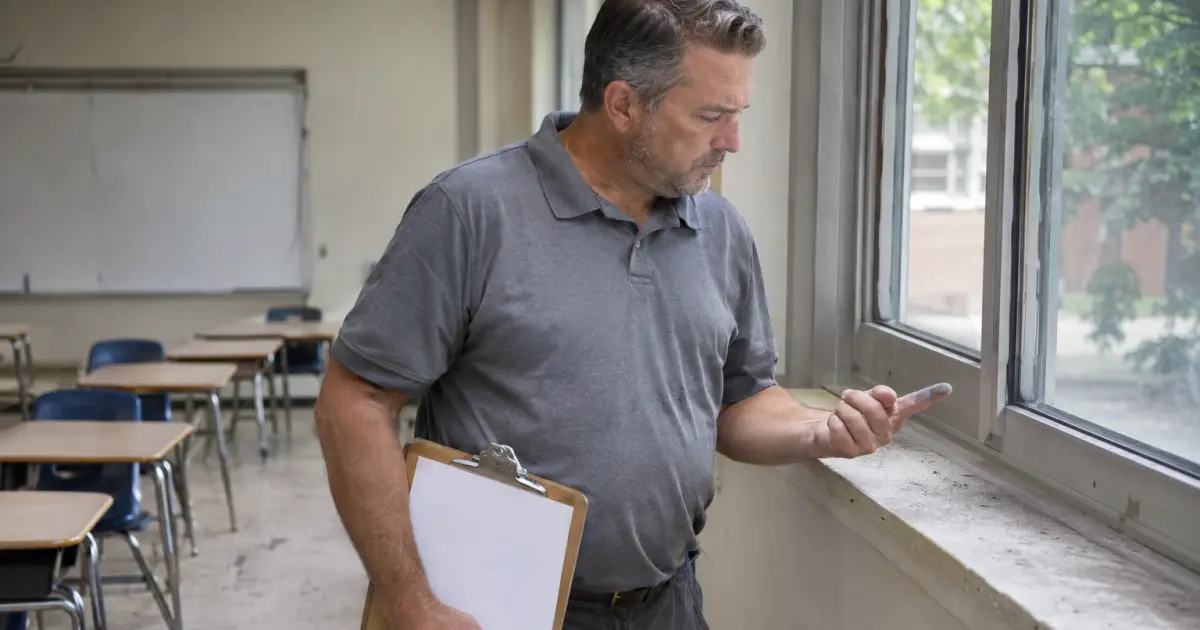
- Desks, sills and other horizontal surfaces free of dust
- Doors, frames and switch plates free of fingerprints
- Trash and recycling emptied, liners replaced
Lobbies, corridors and stairs
- Entrance glass and doors free of smudges
- Walk-off mats clean
- Floors free of gum, stains and debris
- Handrails wiped
- All light fixtures working
Break rooms
- Counters and sinks clean
- Appliance exteriors wiped
- Tables wiped, floors clean
- Trash emptied
How to score the inspection
- Rate every item pass or fail against the standard for that space. A pass means the item meets the agreed APPA level; anything else is a fail.
- Score each category as a percentage: items passed divided by items inspected. If an inspector checks 20 restroom items and 18 pass, restrooms score 90 percent.
- Report categories separately. Do not roll restrooms, floors and offices into one building score.
- Record a severity on every fail, so one sticky floor does not count the same as a restroom with no soap.
- Turn each fail into a re-clean with an owner and a deadline, then re-inspect it and record the result.
California's school facility inspection tool shows both why bands are useful and where a simple score breaks. The tool rates each area in 15 sections as OK, Deficient or Extreme Deficiency, then turns the share of OK ratings into a published band: "Exemplary (99-100 percent)", "Good (90-98.99 percent)", "Fair (75-89.99 percent)" and "Poor (under 75 percent)."
In a November 2024 audit of 18 schools, the California State Auditor found two problems with that design. A classroom with one stained ceiling tile got the same single deficient rating as one with several stained tiles, a torn carpet and peeling paint. And rolling sections up into categories hides failures: "A good score on two of those subcategories could hide problems in a third that scores poor." The auditor recommended separate ratings for cosmetic, minor, moderate and extreme deficiencies, and an end to category-level roll-ups. That is the reason for steps 3 and 4 above.
Where inspection programs break down
Self-scores run high. The same California audit found that "All 18 schools we reviewed across six districts reported higher FIT scores than our inspections supported. On average, schools scored themselves about one score higher overall." Two Los Angeles schools that rated themselves exemplary were rated poor by the auditor. At one of them, "57 of the classrooms we inspected at Manual Arts High School had grime and dust buildup on windowsills, baseboards, and floors."
Inspections happen at the best moment. District maintenance directors told the auditor they inspect "during winter or summer breaks, when custodial staff conduct additional deep cleaning." The auditor inspected "in the spring and after school hours." An inspection right after a deep clean measures the deep clean, not the everyday standard.
Nobody checks the inspector. The state tool "does not require that an inspection be conducted by someone with specific skills or abilities," and the auditor recommended validation of the reports "by a party who did not perform the FIT inspection."
Scheduled inspections do not happen. In Seattle, supervisors were expected to inspect every school "twice a year," and the audit found the inspections were "not currently meeting the 'twice per year' expectation." There were no written procedures, and three facility supervisors covered 96 sites with no administrative support.
The paperwork never existed. In a February 2020 audit of GSA's Northwest/Arctic region, the Office of Inspector General found contracting officer representatives "either did not obtain or obtained inadequate quality control plans for 21 of the 32 service contracts we sampled," and had surveillance plans for only 14 of the 32, none approved as required. For a janitorial contract at the Wayne L. Morse U.S. Courthouse in Eugene, Oregon, no surveillance plan could be completed because the contractor's quality control plan left out landscaping that was in the contract scope. The landscaping died, and GSA paid "an additional $52,000" on another contract for work that was already in the first one.
Staffing sits underneath all of this. The California auditor cites a National Center for Education Statistics estimate that "one custodian should be able to clean from 19,000 to 25,000 square feet per eight-hour shift." When a crew is spread wider than that, a strict checklist will mostly document the shortfall, so check the coverage before blaming the cleaners. Our guide to shift call-out coverage covers keeping those routes staffed.
Make the program hold up
The lessons from those audits are simple to put in place:
- Write the appearance level into the scope, per space type, before anyone is scored against it.
- Inspect on normal days at normal times, with some visits unannounced.
- Sample, then rotate. Pick rooms at random each round so every space gets seen over a quarter.
- Have someone independent check a share of inspections. A facility manager checking a contractor's own quality control reports is the minimum.
- Close every fail. A failed item without a re-clean, a re-inspection and a date is a note, not a quality program. Treat it like any other work order, with a clock on it: see work order response time.
- Keep the records. If you cannot show when an inspection happened, who did it and what failed, it did not happen as far as an auditor is concerned.
Supply shortages show up on inspections too: an empty soap dispenser is a fail whatever caused it. Our guide to janitorial supply inventory covers keeping closets stocked. If you run a cleaning company and want to see what software for this looks like from the contractor's side, read software for facility services companies.
How MAFM handles it
In MAFM, recurring inspections run as daily checklists: task groups on a daily, weekly or monthly frequency, assigned to specific people, with a timestamp on every task they finish and compliance reporting on what was done. A problem found on a round can go in as a service request with a photo and a location, and every step after that carries a time and a name. See the platform overview and the operations solution.
Frequently asked questions
What should a janitorial inspection checklist include?
A list of spaces by type (restrooms, offices, common areas, break rooms) and, for each, items written as visible conditions: floors clean in corners, no dust on horizontal surfaces, supplies stocked, trash emptied. Each item should be rated against a written appearance standard such as one of APPA's five levels.
How do you calculate a cleaning inspection score?
Divide the items that passed by the items inspected and express it as a percentage: 18 passes out of 20 items is 90 percent. Score each category separately rather than averaging them, and record how severe each failure was, so a serious problem in one area is not hidden by good scores elsewhere.
What is an acceptable quality level in a cleaning contract?
It is the amount of defective work the contract tolerates before the service is rejected. Federal procurement guidance warns that it should rarely be zero, and that the contractor must still redo defective work when it can, even when performance is within the AQL.
How often should janitorial inspections be done?
There is no single rule; it depends on the contract and the building. What audits show is that the schedule you set must actually be kept and recorded, and that inspections should happen on ordinary working days, not only after a deep clean.
If your cleaning inspections live on a clipboard that nobody re-reads, talk to an operator who runs recurring checklists and service requests on MAFM every day.