Fire Extinguisher Inspection Requirements for Facilities
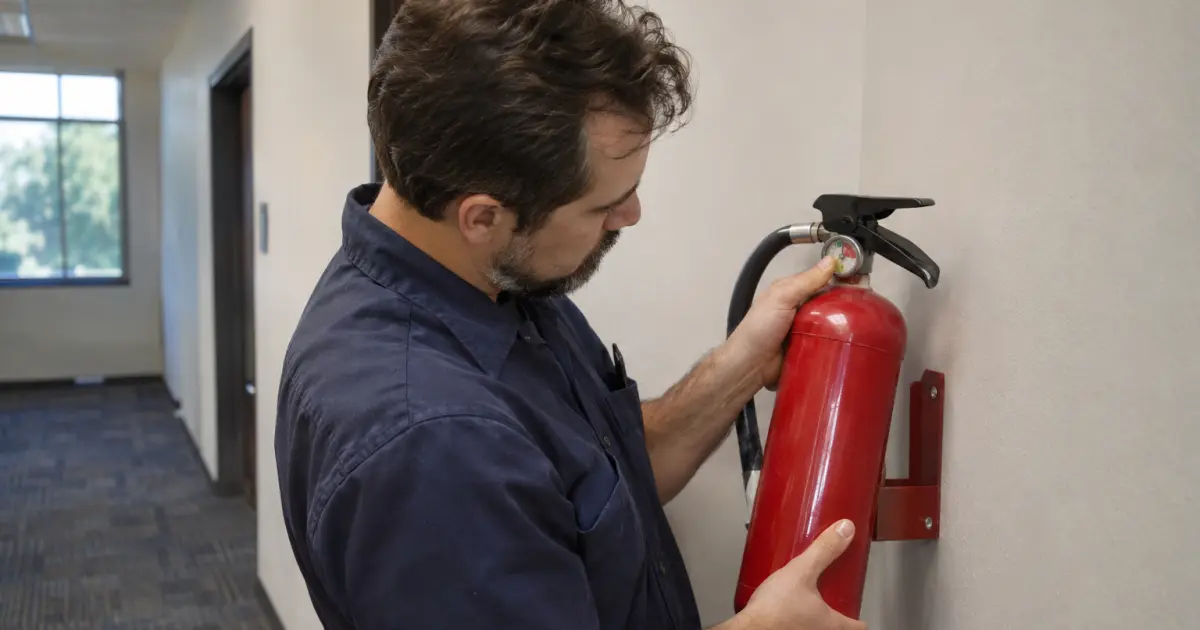
Fire extinguisher inspection requirements come in four layers: a quick visual check of every extinguisher about every 30 days, which your own staff can do; a maintenance check at least once a year by a certified technician; an internal examination every six years for the common stored-pressure dry chemical type; and a hydrostatic pressure test every 5 or 12 years, depending on the extinguisher. Each layer needs its own record, and the owner stays responsible for all of them, even when a vendor does the work.
The monthly check is the one that slips. It is short, it is done in-house, and nobody notices when a month is skipped until an inspector reads the tag.
The four layers at a glance
| Layer | How often | Who does it | What proves it |
|---|---|---|---|
| Visual inspection | Monthly, at about 30-day intervals | Any knowledgeable staff member | Date and initials on a tag, checklist or electronic record |
| Maintenance | At least once a year | Certified technician | Tag with month, year, technician and company |
| Internal examination | Every 6 years for stored-pressure dry chemical | Certified technician | Six-year maintenance label and service collar |
| Hydrostatic test | Every 5 or 12 years, by type | Trained tester with test equipment | Test label or stamp, and a certification record |
What the federal rule says
For workplaces, the baseline is OSHA's portable fire extinguisher standard, 29 CFR 1910.157. It is short and blunt:
- Monthly: "Portable extinguishers or hose used in lieu thereof under paragraph (d)(3) of this section shall be visually inspected monthly."
- Annual: extinguishers must get "an annual maintenance check." The employer must record the annual maintenance date and keep that record "for one year after the last entry or the life of the shell, whichever is less."
- Six years: stored-pressure dry chemical extinguishers that need a 12-year hydrostatic test must be emptied and given the applicable maintenance every 6 years. Disposable, non-refillable units are exempt, and the six-year clock restarts whenever the unit is recharged or hydrotested.
- Coverage while away: when extinguishers are pulled for maintenance or recharging, the employer must provide "alternate equivalent protection." In practice, that means a loaner of the same rating goes on the bracket before the original leaves.
The rule also leaves no doubt about who owns the job: "The employer shall be responsible for the inspection, maintenance and testing of all portable fire extinguishers in the workplace." Even where extinguishers are not meant for employees to use and the employer has emergency action and fire prevention plans, the inspection, maintenance and testing paragraphs still apply.
What the fire code adds
OSHA covers employers. Buildings are also covered by the local fire code, which usually points to NFPA 10, the national standard for portable extinguishers. The edition your jurisdiction adopted decides the details, so check with your local fire marshal, but the core is consistent across the sources we read.
NFPA's own guide to extinguisher inspection, testing and maintenance says inspection is required when an extinguisher is installed "and once a month after that," that "any knowledgeable, competent person" can do it without certification, and that the records "need to be maintained for at least 12 months." Maintenance is different: it "needs to be performed by a certified person."
A current local example shows how the code reads on the ground. Lake Havasu City's fire department specification for portable extinguishers (revised May 28, 2026, citing the 2024 International Fire Code and the 2022 edition of NFPA 10) requires inspection "at approximately 30-day intervals" and says "At least monthly, the date the inspection was performed and the initials of the person performing the inspection shall be recorded." The record can live "on a tag or label attached to the fire extinguisher, on an inspection checklist maintained on file, or by an electronic method that provides a permanent record."
Local rules can also loosen or tighten the schedule. Portland Fire & Rescue's rule FIR-8.03 lets owners of gauged dry chemical extinguishers do 30-day self-inspections "in place of annual servicing," but only inside the fire bureau's approved program, after an inspector confirms the annual, 6-year and 12-year services are current. That is one city's rule, not a national shortcut.
What the monthly check covers
The monthly check takes a minute per extinguisher. The Portland rule lists what to verify:
- It is in its designated place
- Access and visibility are not blocked
- The operating instructions are clear and facing outward
- All seals are intact, with nothing broken, tampered with or missing
- It is full, judged by weighing or "hefting"
- There is no obvious damage, corrosion, leakage or clogged nozzle
- The pressure gauge or indicator is in the operable range
Lift it, do not just look at it. A guide from the Minnesota Department of Health (revised June 2024) explains why: a gauge in the green "is not a 100 percent guaranty," because a broken seal can mean someone discharged a small amount that the gauge does not show. The same guide says extinguishers that are often found blocked, or that sit where they get tampered with or knocked around, may need checking more often than monthly.
How often hydrostatic testing is due
The interval depends on what the shell is made of and what is inside it. OSHA's Table L-1 in 1910.157 sets these for the common types:
| Extinguisher type | Hydrostatic test interval |
|---|---|
| Stored-pressure water and/or antifreeze | 5 years |
| Carbon dioxide (CO2) | 5 years |
| AFFF foam | 5 years |
| Dry chemical with stainless steel shell | 5 years |
| Dry chemical, stored pressure, mild steel, brazed brass or aluminum shell | 12 years |
| Halon 1211 and 1301 | 12 years |
The proof belongs to the employer. OSHA requires a certification record with the test date, the signature of the person who did the test, and the extinguisher's serial number or other identifier, kept until the next test or until the unit leaves service. Non-rechargeable dry chemical units are not hydrotested at all: the Minnesota guide notes they must be removed from service 12 years from the date of manufacture.
Where inspection programs break down
Two recent audits show the same pattern. The checks were planned. What failed was the record, the inventory and the follow-up.
The contract said quarterly. In July 2024, the University of California, Irvine's internal auditors reviewed fire and life safety inspections on campus (report I2024-106). California's Title 19 requires extinguishers to be "manually inspected at least monthly," but the service agreements for four student housing communities run by American Campus Communities said inspections would be quarterly. For nine buildings from January to September 2023, auditors received 19 inspection reports where the regulation called for 81 monthly inspections. Seven of the 19 were not signed or dated, and three buildings had no extinguishers on the inventory at all.
Locked rooms dropped out of the count. On the main campus, a vendor did the monthly rounds. In one building, extinguishers in 76 rooms were not inspected in March 2023 because the rooms were locked or inaccessible, with "no documentation of later attempts to inspect the fire extinguishers." Because the vendor's reports did not record how many extinguishers were in each room, and the campus kept no independent inventory, the auditors could not work out how many extinguishers had been missed.
The tag was there, the initials were not. In a June 2025 audit of care facilities in Maine, the HHS Office of Inspector General found extinguishers not inspected monthly at 3 of the 16 facilities (A-01-24-00004). Its photograph from an unannounced visit on November 19, 2024 shows a monthly inspection tag that "was not filled out for September and October 2024."
The lessons carry straight over to any building or portfolio:
- Keep your own inventory of every extinguisher, by building, floor and room, with its type, serial number and manufacture date. Without it you cannot tell a finished round from a partial one. The Minnesota guide recommends an inventory and floor plan maps for this reason.
- Write the regulatory frequency into vendor contracts. A contract that says quarterly does not change a code that says monthly.
- Treat a skipped extinguisher as an open item, not a note. Locked rooms get a second visit with a key, and the second visit gets recorded.
- Spot-check the vendor. The Irvine action plan has campus staff check extinguisher tags during annual building inspections to confirm the vendor is doing its rounds. The owner stays responsible either way: the Minnesota guide says NFPA 10 puts the duty on the owner, "not the fire extinguisher service company."
- Know where the records are. The same guide suggests that at least two people know where the extinguisher documentation is kept, so it can be produced when an inspector asks.
Extinguishers are assets with their own service clock, so they belong on the same register as the rest of your equipment. Our guide to a physical asset inventory covers how to build and check that register, and how to set a preventive maintenance schedule covers fixed-date tasks like these. If a vendor does the annual service, check their insurance as you would any contractor's: see certificate of insurance tracking.
How MAFM handles it
In MAFM, recurring rounds run as daily checklists: tasks on a daily, weekly or monthly frequency, assigned to specific people, with a timestamp on every task they finish. Each extinguisher can also live in asset management as its own record, with its location, its QR code, inspection tracking and certifications, and a maintenance schedule that sends a reminder when service is due. See the platform overview for checklists and the asset and inventory solution for asset records.
Frequently asked questions
How often do fire extinguishers need to be inspected?
Visually, once a month. OSHA 1910.157 says monthly, and fire codes that adopt NFPA 10 ask for about 30-day intervals. A certified technician must also do maintenance at least once a year. Stored-pressure dry chemical units add a six-year internal examination, and every type has a hydrostatic test every 5 or 12 years.
Who can do the monthly fire extinguisher inspection?
Any knowledgeable, competent person, according to NFPA's guidance; no certification is needed for the monthly check. Annual maintenance, six-year internal examinations and hydrostatic tests must be done by trained, certified technicians.
How long do you keep fire extinguisher inspection records?
NFPA's guidance says monthly inspection records must be kept for at least 12 months. OSHA requires the annual maintenance date to be kept for one year after the last entry or the life of the shell, whichever is less, and hydrostatic test records until the next test or until the extinguisher is taken out of service.
Does a vendor's annual service cover the monthly inspection?
No. Annual maintenance and the monthly visual check are separate requirements, and the building owner or employer stays responsible for both. If a vendor does the monthly rounds too, keep your own inventory so you can confirm every extinguisher was actually reached.
If your extinguisher rounds live on paper tags and a clipboard, talk to an operator who runs recurring checklists and asset records on MAFM every day.