Legionella Water Management Plan: Who Needs One and What It Holds
A Legionella water management plan is a written program that finds the places in a building's water systems where Legionella bacteria could grow and spread, sets a control for each one (temperature, disinfectant, flushing, cleaning), says how and how often each control is checked, and says what staff do when a reading falls outside its limit. It is the industry standard for large buildings under ASHRAE Standard 188, and CDC's toolkit turns that standard into seven steps any facilities team can follow.
Most buildings that get into trouble are not missing a plan because nobody cared. CDC's reviews of outbreak investigations found buildings with no plan at all, and buildings with a plan that nobody followed. The paperwork is the easy part. The weekly readings, the flushing of empty floors and the follow-up on a bad number are where programs fail.
Does your building need a water management plan?
CDC's toolkit opens with a yes/no worksheet. If you answer yes to any of the first four questions, "you should have a water management program for that building's hot and cold water distribution system":
- Is the building a healthcare facility where patients stay overnight, or does it house or treat people with chronic and acute medical problems or weakened immune systems?
- Does it primarily house people older than 65, like a retirement home or assisted-living facility?
- Does it have multiple housing units and a centralized hot water system, like a hotel or high-rise apartment complex?
- Does it have more than 10 stories, including basement levels?
Answer the next four questions whatever your answers above, because they cover devices that spread water droplets: a cooling tower, a hot tub that is not drained between uses, a decorative fountain, or a centrally installed mister, atomizer, air washer or humidifier. The toolkit says these devices "should have a water management program even if the building itself does not," and in a building that already needs a program, they belong in it. A building that answers no to all eight should still maintain its water systems according to the manufacturer's recommendations.
Why it matters: what outbreak investigations found
Legionnaires' disease is a severe pneumonia people catch by breathing in water droplets that contain Legionella. CDC's 2016 Vital Signs report reviewed 27 outbreaks it helped investigate from 2000 to 2014. In the 23 with enough detail to judge, every single one had at least one maintenance deficiency. Inadequate disinfectant levels showed up in 16 of them (70%), and water temperatures in the range where Legionella grows best in 12 (52%). Nearby construction and problems with water mains were the most common outside causes. Three of the buildings already had water management programs, and the report concludes the outbreaks suggest those programs "were inadequate."
CDC's later review of its 2015 to 2019 investigations, summarized on its outbreaks and water management gaps page, is blunter. "All of the deficiencies associated with outbreaks could have been prevented by comprehensive, properly implemented water management programs." The two most common gaps were a building that lacked a program (43%) and a program that would have been adequate but was not followed (40%). CDC's own example of the second kind: "not measuring water heater temperatures as called for in the WMP."
Healthcare buildings carry the highest stakes. CDC's Vital Signs page on health care facilities says Legionnaires' disease "kills 25% of those who get it from a health care facility."
The seven steps of a water management plan
CDC's steps page and its toolkit lay out the program in this order:
- Build a team. Name the people who will run the program, with the skills to do it. CDC suggests training in-house staff or hiring professionals with Legionella experience.
- Describe the water systems. Use flow diagrams and a written description: how water enters the building, how it is distributed, where the water heaters, boilers, hot tubs and cooling towers are, and where the building connects to the municipal supply. Plumbing blueprints help.
- Find where Legionella could grow and spread. Look for places where water temperature could support growth or where flow might be low.
- Set control measures, limits and monitoring. For each hazardous condition, decide the control measure (an action such as heating, adding disinfectant or cleaning), the control limit (the acceptable maximum, minimum or range), the control point (where it is applied), and where and how it is monitored.
- Decide what happens when a limit is missed. Write down the corrective action for each reading that comes back outside its limit.
- Make sure the program runs as designed and works. Verification asks "Are we doing what we said we would do?" Validation asks whether the program actually controls the hazards, and environmental testing for Legionella is one way to check.
- Document and communicate everything. Keep the plan, the readings and the corrective actions on record, and train the people responsible whenever the plan changes.
What to watch in the building
The toolkit lists what helps Legionella grow:
| Condition | Why it matters |
|---|---|
| Water temperature | Legionella "grows best (77°F–113°F)" and can still grow outside that range |
| Stagnation | Low flow "encourages biofilm growth and reduces temperature and levels of disinfectant" |
| Inadequate disinfectant | Heating, storing and filtering water use up the disinfectant it arrived with |
| Biofilm | Protects Legionella from heat and disinfectant and "can last for decades" |
| Scale and sediment | Uses up disinfectant and gives bacteria a protected home |
| Pressure changes | Can knock biofilm loose and colonize downstream devices |
| pH | Disinfectants work best in a narrow range, about 6.5 to 8.5 |
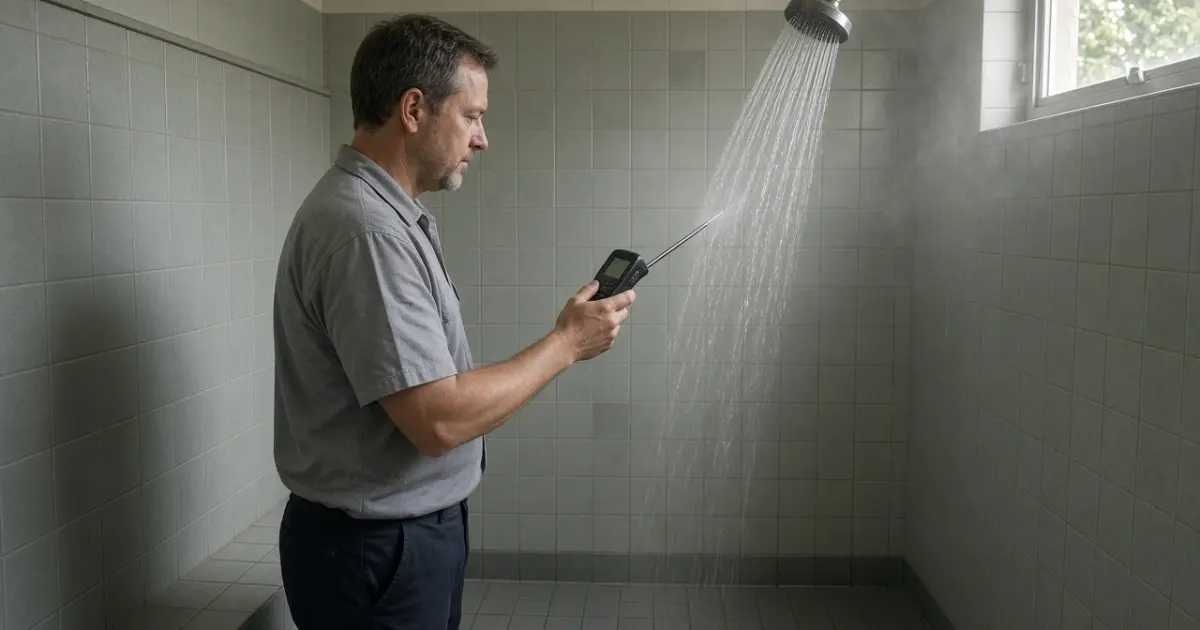
Hot water drops into the growth range more easily than most people expect. The toolkit names low water heater settings, heat loss in long pipe runs, hot and cold water mixing in the plumbing, hot and cold pipes running too close together, and stagnation. In hot weather, cold water lines can warm into the range too. Stagnation is the quiet one: renovations that leave "dead legs" of capped pipe, floors with low occupancy, and fixtures nobody uses, "like a rarely used shower in a hospital room."
One trade-off belongs in the plan in writing. The toolkit notes that the maximum hot water temperature a state allows to prevent scalding "may be too low to limit Legionella growth," and points to mixing valves at or near the point of use, which keep the water in the pipes hot while delivering safe water at the tap.
You do not need to measure every tap. The toolkit's example building monitors "at representative fixtures close to and far from the central distribution point."
When to review and update the plan
CDC says to review the program at least once a year, and again when:
- Readings are persistently outside their control limits
- A major maintenance or water service change happens: new construction, new equipment, a change of disinfectant or treatment product, a seasonal change in water use, or a change in the municipal water supply
- One or more cases of disease are thought to be linked to the building
- The laws, regulations, standards or guidelines that apply to you change
It also asks you to plan ahead for the events that upset water quality: system start-up and shutdown, scheduled maintenance, renovation and construction, equipment failure, and water main breaks. In the toolkit's own example, a building engineer whose eighth floor is closed for renovation flushes the sinks and fixtures with hot and cold water every day, raises temperature and chlorine checks on that floor from weekly to daily, and records each flush and reading in his log.
What CMS expects from hospitals and nursing homes
CMS first set out its expectations in a 2017 memo, QSO-17-30, revised in 2018. It said "Facilities must have water management plans and documentation" that, at a minimum, include a risk assessment, a program that considers the ASHRAE standard and the CDC toolkit, and testing protocols with acceptable ranges, documented results and corrective actions. CMS's site now marks that memo expired, and the guidance lives in the State Operations Manual:
- Nursing homes, Appendix PP, tag F880: facilities "must be able to demonstrate" their measures to minimize the risk of Legionella, "such as by having a documented water management program," based on nationally accepted standards and including an assessment of where waterborne pathogens could grow and spread, control measures, and how they are monitored.
- Hospitals, Appendix A, tag A-0750: CMS "expects Medicare certified hospitals to have water management policies and procedures," and says hospitals "should consider implementing a water management program that considers the ASHRAE industry standard and the CDC toolkit." Surveyors review the program documentation where one exists.
Appendix PP also says that "CMS does not require water cultures for Legionella" as part of routine program validation, though testing may be needed after a case or a possible outbreak.
Cooling towers: New York City's rules
Cooling towers spray warm water into the open air, which is why a single tower can sicken a neighborhood. In the summer of 2015, one cooling tower on a South Bronx hotel was linked to 138 cases and 16 deaths, according to the city's investigation published in Public Health Reports. City agencies did not know that tower existed until it was found on satellite imagery. The outbreak led to New York City's cooling tower law.
The NYC Health Department says about 4,000 buildings have registered cooling towers. After a 2025 Central Harlem cluster of 118 cases and seven deaths, the rules were tightened. Since May 8, 2026, owners must test each operating tower for Legionella every month, with no more than 31 days between samples, up from every 90 days. The penalty schedule in the amended rules shows what the city checks: a missing maintenance program and plan ($2,000 for a first violation), routine monitoring not documented at least once a week, and compliance inspections not documented at least once every 90 days while the tower is in use.
Outside New York, check with your state and local health department. The CDC toolkit says to follow all relevant laws and to adhere to them where they conflict with its guidance.
Where plans break down in practice
The VA Office of Inspector General's 2013 inspection of the VA Pittsburgh Healthcare System, after an outbreak, is a useful list of the failures that matter. The OIG found the system "inadequately managed its water treatment systems during 2011–12," did not routinely flush hot water faucets and showers as the treatment system's manufacturer recommended, and responded to positive cultures with corrective actions that did not match VA or CDC guidance. One of its recommendations was close coordination between the infection prevention team and facilities staff.
None of those are design failures. They are routine tasks that slipped and follow-ups that were not done. That matches CDC's finding that 40% of outbreak gaps were plans that existed but were not followed.
A routine that keeps the plan alive
This is our synthesis of the CDC toolkit and the findings above, not a code requirement. Check it against your own plan and your local rules.
- List every control point as an asset. Water heaters, storage tanks, mixing valves, cooling towers, fountains, ice machines, eyewash stations. Each one gets a location and a record.
- Put every reading on a fixed schedule. Temperature at representative near and far fixtures, disinfectant levels, and visual checks, each on the frequency your plan sets, assigned to a named person.
- Write the limit next to the reading. A temperature logged without its limit cannot be judged by the person who logs it.
- Turn every out-of-limit reading into a work order. The corrective action, who did it and when, then a repeat reading to confirm.
- Flush what nobody uses. Closed floors, vacant suites and rarely used showers go on a flushing round, recorded like any other task.
- Have someone else verify. CDC says people "should not verify the program activity for which they are responsible." The person who maintains the hot tub checks the cooling tower log, and the other way round.
- Review the plan once a year and after every trigger. Construction, a main break, a change of treatment product, or a case of disease.
The control points in a water plan belong on the same register as the rest of your equipment. Our guide to a physical asset inventory covers how to build it, and how to set a preventive maintenance schedule covers recurring tasks like temperature rounds. The same discipline applies to life-safety checks such as emergency lighting testing, and work order response time covers how fast a reported problem should be closed.
How MAFM handles it
In MAFM, recurring rounds run as daily checklists: tasks on a daily, weekly or monthly frequency, assigned to specific people, with a timestamp on every task they finish. Each water heater, tank or cooling tower can also live in asset management as its own record, with its location, its QR code, inspection tracking and certifications, and a maintenance schedule that sends a reminder when service is due. See the platform overview for checklists and the asset and inventory solution for asset records.
Frequently asked questions
What is a Legionella water management plan?
It is a written program that identifies where Legionella could grow and spread in a building's water systems, sets control measures and limits for each of those places, explains how they are monitored, and says what to do when a limit is not met. ASHRAE Standard 188 sets the industry standard, and CDC's toolkit explains how to build one in seven steps.
Is a Legionella water management plan required by law?
It depends on the building. CMS expects Medicare-certified hospitals to have water management policies and procedures, and nursing homes must be able to demonstrate their Legionella risk measures, such as with a documented program. Some cities and states have their own rules, such as New York City's cooling tower law. For other buildings, it is the industry standard rather than a federal requirement.
What temperature does Legionella grow in?
CDC's toolkit says Legionella grows best between 77°F and 113°F, and can still grow outside that range. Hot water that cools in long pipe runs or sits unused, and cold water that warms in hot weather, can both drift into that range.
How often should a water management plan be reviewed?
At least once a year, according to CDC, and again whenever readings stay outside their limits, a major maintenance or water service change happens, a case of disease is linked to the building, or the rules that apply to you change.
Do you have to test the water for Legionella?
Not always. CDC calls environmental testing one way to validate that a program works, and CMS does not require Legionella water cultures as part of routine validation in nursing homes. Some rules do require it: New York City requires cooling towers to be tested every month while they operate, with no more than 31 days between samples.
If your water temperature readings live on a clipboard in the boiler room, talk to an operator who runs recurring checklists and asset records on MAFM every day.