Emergency Lighting Testing Requirements: Monthly and Annual
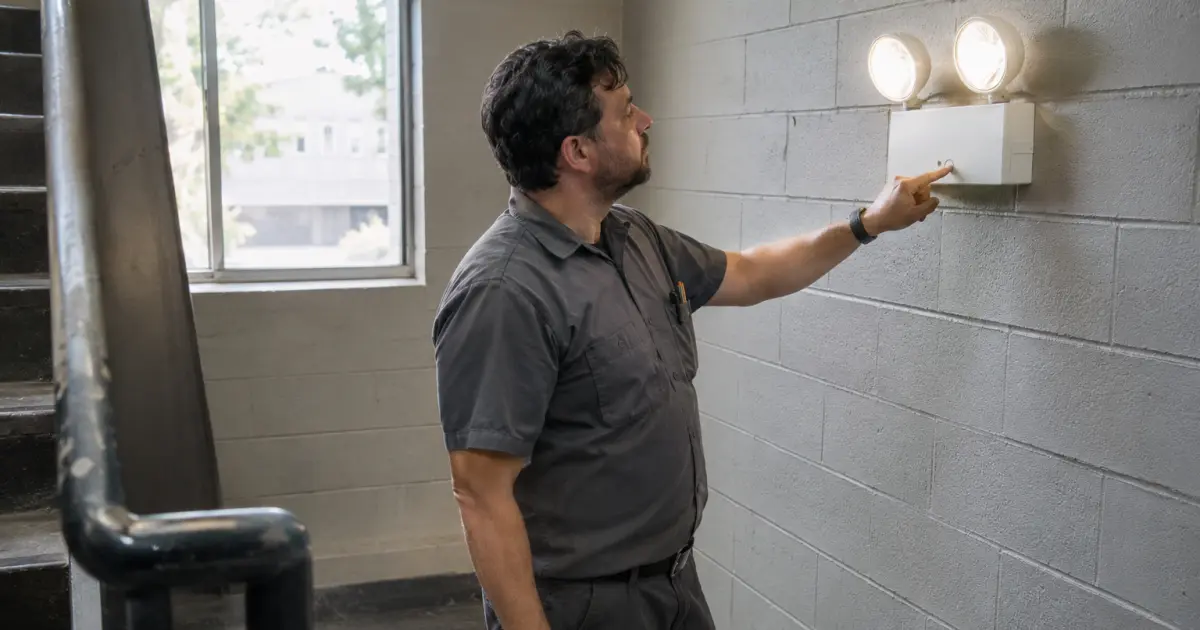
Emergency lighting testing requirements come down to two tests and a record. Under NFPA 101, the Life Safety Code, every required emergency light gets a functional test of at least 30 seconds once a month, and battery-powered units also get a test of at least 90 minutes once a year. The owner keeps written records of both for the fire marshal. Illuminated exit signs that run on emergency power are tested the same way.
The tests are simple. What fails in practice is the same thing that fails with fire extinguishers: units that were installed and forgotten, months that were skipped, and logs that were never written, so the work cannot be proven when an inspector asks.
The two tests at a glance
| Test | How often | How long | What it proves |
|---|---|---|---|
| Functional (button) test | Monthly | At least 30 seconds | The unit switches to battery and the lamps light |
| Duration (power) test | Once a year, battery units | At least 90 minutes (1½ hours) | The battery can carry the lamps for the full rated time |
| Record | Every test | Date, unit, result and who did it, kept by the owner |
What NFPA 101 requires
Depending on what your jurisdiction adopted, the emergency lighting rules usually come from NFPA 101 or the International Fire Code, and the two agree on the core schedule. Section 7.9 of NFPA 101 covers emergency lighting; 7.9.3 covers periodic testing. Check which edition your jurisdiction adopted, because the wording has shifted between editions.
Performance. A summary of NFPA 101 published by the University of Colorado's Fire and Life-Safety Group, citing the 2009 edition, says emergency illumination must last "not less than 1½ hour" when normal lighting fails, with an initial average of 1 foot-candle along the path of egress at floor level. It must come on automatically when the utility fails, when a breaker or fuse opens, or when someone accidentally switches off the normal lights.
The monthly test. The 2012 wording, which a California fire district's testing guide quotes, reads: "Functional testing shall be conducted monthly with a minimum of 3 weeks and a maximum of 5 weeks between tests, for not less than 30 seconds." Older editions said "at 30-day intervals." Either way, "once a month" at random dates can still break the rule: a test on March 2 followed by one on April 28 is eight weeks apart.
The annual test. "Functional testing shall be conducted annually for a minimum of 1½ hours if the emergency lighting system is battery powered." The equipment has to be fully operational for the whole duration of both tests, so a lamp that dims out at minute 70 is a failed test, not a pass.
The record. "Written records of visual inspections and tests shall be kept by the owner for inspection by the authority having jurisdiction (AHJ)."
NFPA's own NFPA Journal article on emergency lighting and exit marking explains the purpose of each test. The monthly one, usually done with "a test button that disconnects the main power to the unit," checks "that the battery is holding more than a residual charge" and that the lights work. The annual one runs for "a minimum of 90 minutes to test the full capacity of the batteries."
What the International Fire Code says
The International Fire Code puts the same schedule in plainer words. In the 2018 edition, Section 1031.10 (the number moves between editions):
- Activation test: "Emergency lighting equipment shall be tested monthly for a duration of not less than 30 seconds." The test can be manual or "an automated self-testing and self-diagnostic routine."
- Power test: "Battery-powered emergency lighting equipment shall be tested annually by operating the equipment on battery power for not less than 90 minutes."
Where self-testing equipment does the monthly test, the code still asks for "a visual inspection of the emergency lighting equipment" every month, to catch any unit "displaying a trouble indicator or that has become damaged or otherwise impaired."
Manual, self-test or computer-based
NFPA 101 allows three ways to meet the schedule. The University of Colorado summary lists them as sections 7.9.3.1.1 to 7.9.3.1.3:
- Manual testing. Staff press each unit's test button for 30 seconds every month and run the 90-minute test every year, then write it down. Cheapest equipment, most labor.
- Self-testing, self-diagnostic units. Each unit runs its own 30-second test and a diagnostic routine at least every 30 days and shows a failure on a status indicator. Someone still walks the building at least every 30 days to look at the indicators, and records are still kept.
- Computer-based self-testing. The units test themselves monthly and annually, and the system must be able to report "the history of the test and failures at all times." NFPA's Journal article says a 30-day visual inspection is not required with this method, because problems are reported and logged by the computer.
One point to settle with your fire marshal: the code text summarized by the University of Colorado still lists an annual 1½-hour functional test for stand-alone self-test units, while NFPA's Journal article says those units "do not need to be manually tested monthly or annually." Until your AHJ tells you otherwise in writing, keep the annual test on the calendar.
Exit signs and generator-backed lighting
Exit signs. NFPA's Journal article says the illumination of exit signs "needs to be confirmed via a visual inspection at intervals not exceeding 30 days," and where the occupancy also needs emergency lighting, the signs need emergency power and "the same methods of testing" apply. In practice, battery-backed exit signs go on the same list as the emergency lights.
Generators. Some buildings light the egress path from a generator and transfer switch rather than battery units. In that case, NFPA says, the generator's inspection, testing and maintenance follow NFPA 110, the standard for emergency and standby power systems. The 90-minute battery test is for battery-powered equipment.
What OSHA requires
OSHA does not set a test schedule, but it sets the outcome. Under 29 CFR 1910.37, "Each exit route must be adequately lighted so that an employee with normal vision can see along the exit route," and "Each exit sign must be illuminated to a surface value of at least five foot-candles (54 lux) by a reliable light source." A dead battery unit in a windowless stairwell during an outage is the moment those two sentences stop being true.
Healthcare buildings: what surveyors check
Hospitals, nursing homes and other facilities in Medicare and Medicaid are surveyed against the 2012 edition of NFPA 101. On the Form CMS-2786R Fire Safety Survey Report, tag K291 checks that "Emergency lighting of at least 1-1/2 hour duration is provided automatically in accordance with 7.9," and K293 checks exit signs with "continuous illumination also served by the emergency lighting system." The 3 to 5 week window in the 2012 wording is the one surveyors read.
Where emergency lighting programs break down
The HHS Office of Inspector General has made unannounced visits to nursing homes in several states and checked their life safety equipment. Emergency lighting turned up in report after report, and the pattern is records and follow-through, not missing equipment.
Texas, February 2020. In A-06-19-08001, covering 20 nursing homes: "Four nursing homes had not performed the most recent monthly inspection of the emergency lighting and exit signs prior to our visit, or these did not illuminate when tested."
Iowa, February 2021. In A-07-19-03238, also 20 nursing homes, "nine facilities had not properly inspected both emergency lighting and exit signs, or these did not illuminate when tested." The auditors judged that from two things: inspection records that were "incomplete or missing," or lights and signs that stayed dark when tested. One photograph in the report is captioned "Emergency lighting not working when tested."
Oklahoma, January 2024. In A-06-22-09007, five of 20 nursing homes had "missing or non-illuminated exit signs and the lack of documentation for required emergency lighting testing."
Fire inspectors outside healthcare say the same. The North County Fire Protection District's guide opens with it: "Frequently, inspectors find that emergency lighting units have been installed and subsequently forgotten." It also warns about the most common false comfort: "The 'charging' light may be lit on the units, but this does not guarantee the lights will come on when the power fails."
A testing routine that holds up
The rules and the audit findings point to the same routine. This is our synthesis, not a code requirement, so check it against your adopted code.
- Number every unit. Keep a list of every emergency light and battery-backed exit sign by building, floor and location, with its type (manual, self-test or computer-based). You cannot prove a finished round without knowing how many units there are.
- Test on a fixed day each month. The first Tuesday, say. A fixed day keeps you inside the 3 to 5 week window without anyone counting.
- Hold the button for the full 30 seconds. Watch both lamps. A unit that does not light, lights dim, or drops out before 30 seconds fails, and the fire district guide says it "should be serviced, repaired, or replaced."
- Cut real power for the annual test. The same guide says the annual test needs the power "actually be interrupted to the emergency lighting unit, by unplugging it, throwing a circuit breaker, or other safe means." Run it outside occupied hours, because a unit that just ran 90 minutes on battery has little left until it recharges.
- Log every unit, every time. The fire district's sample log has columns for test date, monthly or annual, unit number, start time, stop time, pass, fail, reason for fail and the tester's initials. That is a good minimum.
- Turn every failure into a work order. A failed test written on a log and never repaired is the finding from the Iowa report. Track the repair to completion and retest the unit.
- Keep the records where someone else can find them. The code says the owner keeps them for the AHJ. If a vendor does the testing, get a copy of every log, unit by unit.
Emergency lights are assets with their own service clock, so they belong on the same register as the rest of your equipment. Our guide to a physical asset inventory covers how to build that register, and how to set a preventive maintenance schedule covers fixed-date tasks like these. The same inspector who reads your emergency lighting log will also read the extinguisher tags: see fire extinguisher inspection requirements. For how quickly a failed unit should be fixed once it is reported, see work order response time.
How MAFM handles it
In MAFM, recurring rounds run as daily checklists: tasks on a daily, weekly or monthly frequency, assigned to specific people, with a timestamp on every task they finish. Each emergency light can also live in asset management as its own record, with its location, its QR code, inspection tracking and certifications, and a maintenance schedule that sends a reminder when service is due. See the platform overview for checklists and the asset and inventory solution for asset records.
Frequently asked questions
How often do emergency lights need to be tested?
Monthly for at least 30 seconds, and once a year for at least 90 minutes if they run on batteries. That is the schedule in NFPA 101 and the International Fire Code. The 2012 edition of NFPA 101 adds that monthly tests must be 3 to 5 weeks apart.
What is the 90-minute emergency light test?
It is the annual test of battery-powered emergency lighting. Normal power to the unit is cut and the lamps must stay fully lit on battery for at least 90 minutes (1½ hours), which proves the battery still holds its full rated capacity.
Do self-testing emergency lights still need monthly checks?
Yes, a visual one. Self-testing units run their own monthly test, but both NFPA 101 and the International Fire Code still ask for someone to look at each unit at least every 30 days for a trouble indicator or damage. Computer-based systems that log every test are the exception under NFPA 101.
Who keeps the emergency lighting test records?
The owner. NFPA 101 says written records of visual inspections and tests are kept by the owner for inspection by the authority having jurisdiction, even when a contractor does the testing.
Does OSHA require monthly emergency light testing?
OSHA does not set a testing schedule. Its rule, 29 CFR 1910.37, requires exit routes to be adequately lighted and exit signs to be illuminated by a reliable light source. The monthly and annual tests come from the fire code your jurisdiction adopted.
If your emergency light checks live on a clipboard in the maintenance shop, talk to an operator who runs recurring checklists and asset records on MAFM every day.